


–A friend asked “Jim how are you —really?”
I thought, “Must be a trick question.”
Not a trick by the asker
but trick by
my inner magician,
my personal convoluter,
my lithe prevaricator
who first teased Eve
under a tree
with the acid, orange
kumquat of knowledge
which he bounced
upon his forked tongue
and upon which Eve
and her shifty lover
sadly choked
The question,
How are you, really?
is impossible for a fake
to bear
To answer would be
to mock God
who sees through spin
no matter how sincere
Better to say,
Gooder ‘n some
Better to say,
Badder ‘n others
Better to say,
A mixed bag complex.
A hick in a zoot suit
A pansey in a bucket
of muck
I keep up appearances
I do my thing
I balance odds and ends
as best I can
I go not where the four
winds blow
You want the naked truth?
Let me think about it ’cause
I don’t know
poonany:
leffelovesdestrua:
Sharing this because I had NO IDEA that this is how they worked…
This is sexual

10oclockdot:
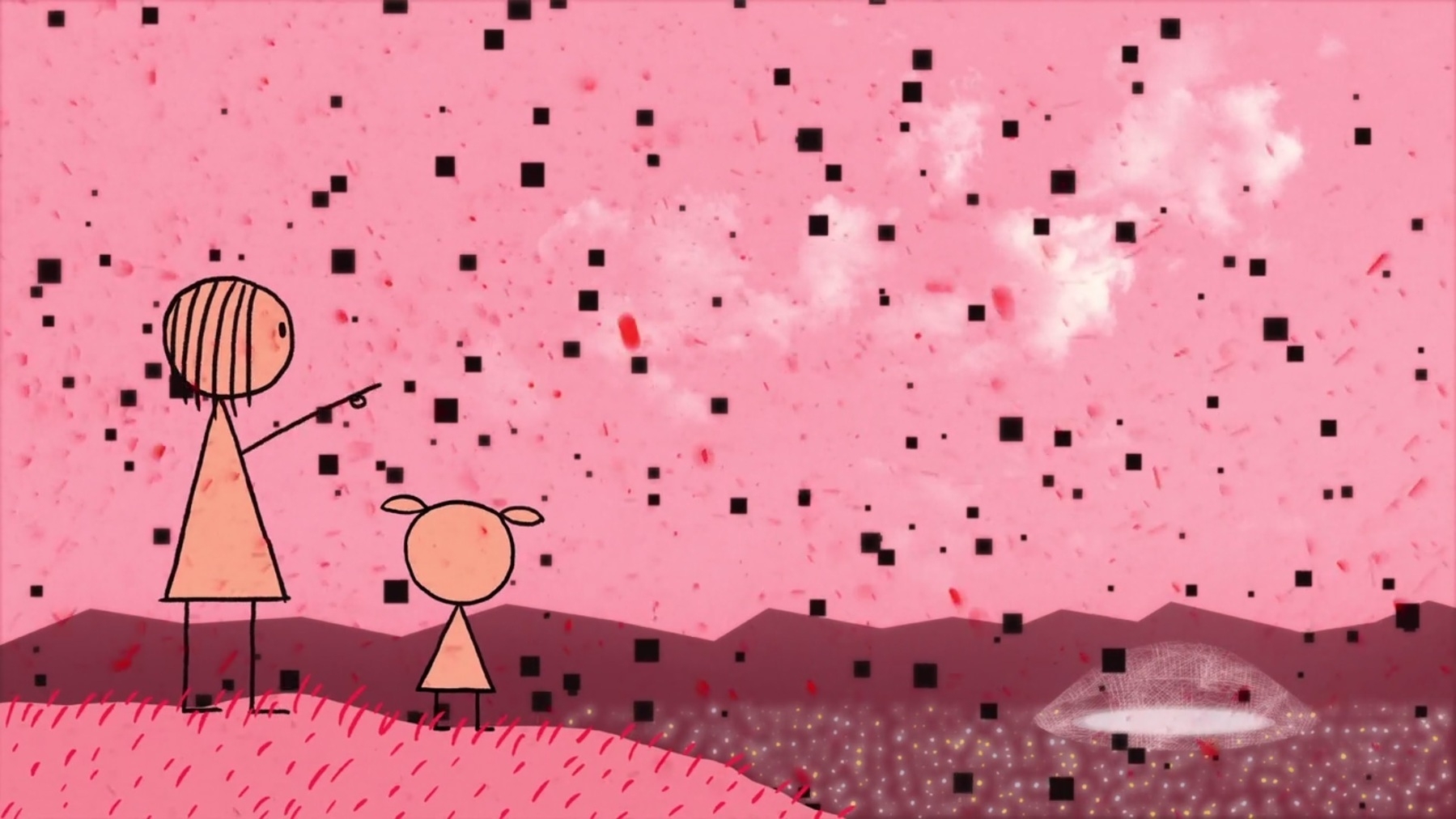
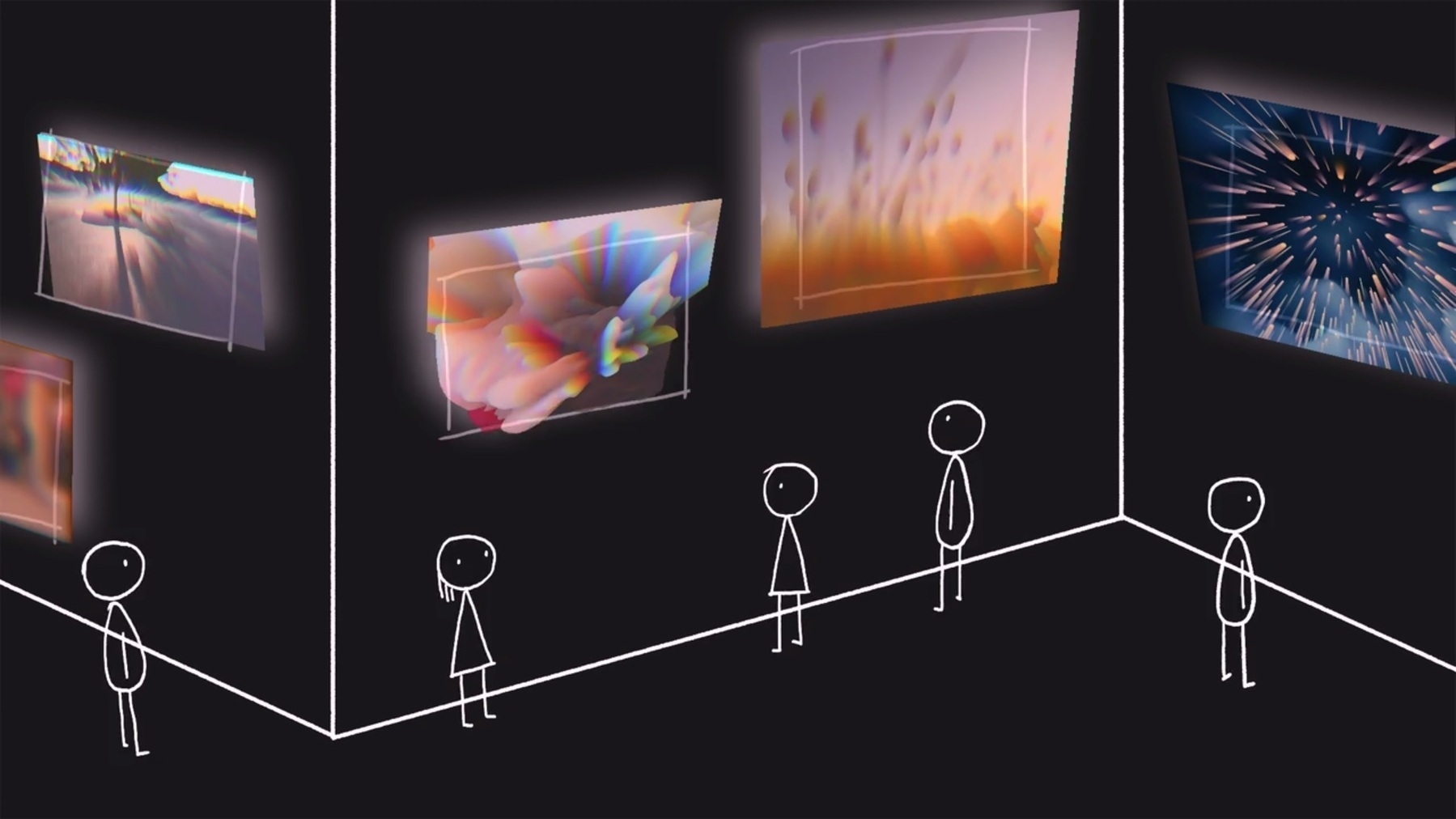
Catching Up #22: World of Tomorrow (dir. Don Hertzfeldt, 2015) It’s been about a week since Netflix began streaming Don Hertzfeldt’s 2015 short World of Tomorrow, which I think is long enough to qualify for an episode of Catching Up (given how much I love Hertzfeldt). In my July 2013 write-up on Hertzfeldt for The Final Image, I opened with the following observation: “Until recently, Don Hertzfeldt’s short animated films could be mistaken as nothing more than insidiously macabre comedy. But with the completion of his recent trilogy It’s Such a Beautiful Day…, it has become clear to me that Hertzfeldt’s films concern nothing less than the fundamental act of creation. And by creation, I don’t just mean artistic creation. I mean the wresting of a cosmos out of a primordial state of chaos.” (here) Without fail, World of Tomorrow rises to this description and breathtakingly surpasses it. Not only has Hertzfeldt imagined a new future-universe more insightfully, more beautifully, and more totally than in any previous project, he surrounds us with it so immediately that he even has time to destroy it all, too. Now, this appetite for destruction has always overrun Hertzfeldt’s films. But here the bizarre violence and deadpan dark humor have almost disappeared entirely, opening a new space for legitimate philosophical musings on the entwined natures of time and death. When news of Abe Vigoda’s death reached me yesterday, I recalled that in the early 80’s People Magazine had accidentally printed that he was dead, and this greatly-exaggerated report of his death has been played for humor ever since. But in the same way that the Twitter account which reproduced On Kawara’s I Am Still Alive postcards (as tweets) for the digital age took on greater significance the moment Kawara died, the jokes about Abe Vigoda’s death take a strange conceptual turn now that he has actually died. Suddenly, albeit 34 years late, People’s erroneous report is accurate. This led to a further thought: each human life occupies a slim sliver of time compared to the total duration of human civilization, and a still-more-vanishingly-minute shaving of the total age of the earth or the universe. Why not, then, print that all living persons are dead? Sure, the report would be momentarily inaccurate, but then eternally correct not long thereafter. World of Tomorrow addresses the awesome scope of time from a similar matter-of-fact, melancholy perspective, pitting the frailty of human attempts to beat time against the thermodynamic guarantee of eventual annihilation. In World of Tomorrow, a clone from the future visits her past self as a child and, through time travel, introduces the pre-K progenitor to the title topos. In the future, it seems that most of human activity is organized around trying (and failing) to escape death. The elderly upload their brains into cubes (apparently a terrifying procedure), the young clone themselves (but the copies are imperfect and invariably deteriorate and die), the human race spends most of its time looking at screens displaying the world of the past or going in search of lost memories, and the poor, seeking any route of salvation from an imminent asteroid impact (in the future), turn to cheap time-travel, which, due to math errors, throws their bodies into space to burn up resplendently on re-entry. (I especially respect this terse analysis of class.) Most profoundly, the clone-guide takes her toddler-grandmother on a tour of one of her treasured memories: a controversial art exhibit which she viewed when she was young. The artist placed a brainless human clone in a vitrine alive, allowing it to age and decay for the course of a human life, and eventually die. The clone-guide recalls how people grew very fond of the boy in the vat, naming him, returning to visit of the course of decades, and mourning his death. As I watched this scene, I asked myself whether it was the lot of humans to be unable to truly understand something without an artwork to reveal the retrospectively-obvious. What else was this imagined art project except an analysis of the effects of time on humans? Haven’t we all aged? Haven’t we seen people we’ve loved age and die? Don’t we wish that we could stop time and preserve beloved things in a changeless state? Don’t we always fail? The conceptual elegance knocked me over. And here it hit me that Hertzfeldt seems to have embarked upon a new project in this film to distill the human condition down to some fundamental element of pathos. Before, Hertzfeldt defended himself against time and decay with a fusillade of bitter, macabre humor, obscuring the fact that these themes have (almost) always been his primary focus. But in World of Tomorrow, the jokes have fallen away almost entirely, leaving the artist naked among these cold realities. And thus, he found it: the common feature of all human pathos is our drive to stop time, in which we always fail, and for which we always try again, every day, again and again, until we die. “Now is the envy of all of the dead,“ the clone-guide tells her past self. Elsewhere, she also remarks: “I am very proud of my sadness, because it means I am more alive.” Hertzfeldt might say the same. For the moment anyway. We’re all doomed to go soon enough. But for today, It’s Such a Beautiful Day. Or, as the girl squeals in the final line of World of Tomorrow, “What a happy day it is!”


10oclockdot:
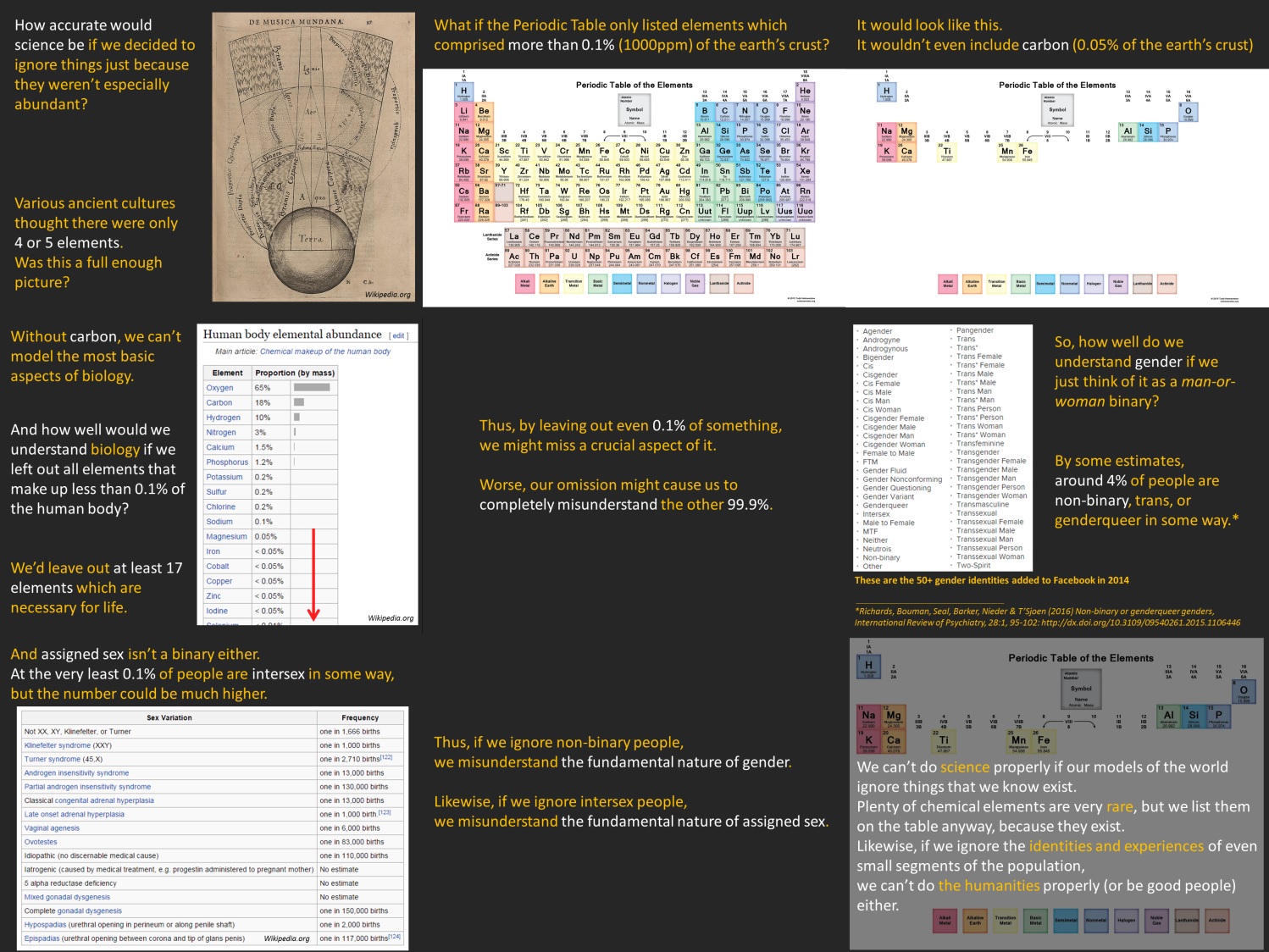
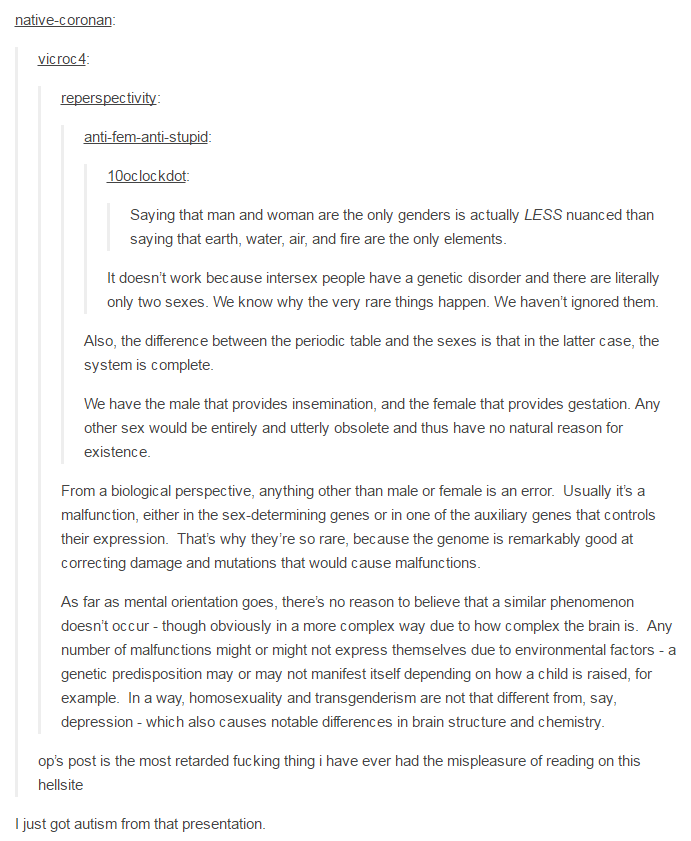
As you see above, I received some passionate feedback on the powerpoint slides I posted six days ago (here). Though I doubt that the rebloggers above are reading this, I’d like to respond to the constructive feedback at the top. The first three posters all assert some version of the same basic argument (as did others who replied): intersex is an error, a disorder, something with “no natural reason” for being, and therefore thinking of assigned sex as male-or-female binary is appropriate. I disagree with their position on this, and I think it’s important to talk about why. One of them asserts that “from a biological perspective” intersex is an error. But what does that phrase “from a biological perspective” mean? From the perspective of pure science? From the perspective of an applied science (like medicine)? What exactly is a scientific perspective?
- I’d like to argue that this isn’t a debate about science. It’s a philosophical debate, specifically a debate dealing with purposes of things; that is, it’s a debate over teleology. The relationship between teleology and science is a complex one, and for a long time many purportedly purely scientific assertions have been draped in teleological language: that is, language which declares or implies purpose or goal-orientedness. For instance, a biology textbook might declare, “It is the purpose of the spleen to filter the blood.” While “purpose” might be a useful shorthand for common function, they aren’t strictly the same thing. To declare that any system has a purpose or a goal (a telos), is to declare the presence of either a designer (who designed with that goal in mind) or at least some universal standard of proper function. But neither of these things can be demonstrated to exist in nature, so to say that the “purpose” of the spleen is to filter the blood is, though sometimes a useful shortand, false.
- Teleological language is often pardonable, especially in clinical settings. After all, if you’d like to live a healthy life, you’d want your spleen to filter your blood. And you might, quite reasonably, refer to this as your spleen’s purpose and any variation from it an “error” or “disorder.” But in this case, the patient and the doctor have declared the spleen’s purpose based on certain criteria (“I want to live a healthy life”). This declaration of purpose is not self-evident from biology (the spleen doesn’t come with a manual or a warrantee), nor is it a purely scientific statement. Science is in the business of describing and modeling physical phenomena. It does not ascribe purposes or goals, nor does it evaluate phenomena (as good or bad, correct or in error, etc.).
- Still, nearly everything about life LOOKS goal-oriented. After billions of years of evolution, creatures have gotten pretty good at avoiding death and passing along their genes. They look designed for a purpose. But as we know, they (and we) are not so designed. Life came about by random events, certain mutations furnished an adaptive advantage, these advantages were preserved in the genetic code, allowing later generations further adaptations, and here we are. Natural selection (a vast phenomenon of forces), does not, as its name implies, select anything, much less design anything. The manifold forces that comprise what we call “natural selection” merely de-select. They filter, they kill. But they do so without agency or will or design. Drop a thousand Plinko chips down the board, and some will fall into the $10,000 slot, and others will fall into other slots. But the pegs don’t “select” certain chips to be winners, and neither does gravity or friction or the player or the chips themselves. The minimally complex system of chaotic collisions produces a normal distribution without will, intent, thought, or purpose. Physics just runs. Things happen.
- Same with natural selection. Out of this maximally complex system of systems of uncountable contingent events, life emerged, then multicellular life, and later bones and hearts and eyes and brains and so forth. As it happens, most cells and organs and systems of organs behave in reasonably predictable ways. But even that doesn’t mean that they were designed TO DO what they do. DNA mutates, it builds organs, adaptive advantages reproduce, and so on, but the DNA does none of this with purpose, just as natural selection does nothing with purpose. And on an evolutionary timescale, no attribute of any species is ever permanently fixed, as all species are continually changing into other species all the time.
- For a long time, scientists and the natural philosophers before them didn’t understand the contingent and dynamic nature of nature, and they pardonably ascribed fixed identities and concrete purposes to nearly everything. But we know better now, and we do science differently now. Pure science is in the business of describing and modeling that which exists. As such, science shouldn’t make evaluative judgments like, “Carbon is the best element” or “Quasars are mistakes.” That which exists exists. From a purely scientific perspective, existence is neither good nor bad. That said, there are plenty of reasons to greet scientific data with some sort of evaluative statement, like, “4 degrees of warming would be disastrous,” or “At the time, outhouses were a public health triumph.” But in both of these statements (or any like them), the judgments are being made with criteria outside of science. Science says, “this is.” To say, “this is good” or “this is bad” (or any other judgment), you’re bringing in ethical, moral, philosophical, political, or even religious criteria. (In fact, the idea that “science is good” cannot be proclaimed scientifically; it takes a philosophical stance to say that.)
- So, what about people who are intersex? We can declare that the PURPOSE of human life is to reproduce, and thus that infertility is a “disorder” (n.b.: some intersex people are infertile, but not all), but as I argued above, this declaration does not derive from science. Because it declares purpose, it’s a philosophical statement. So don’t claim that “from a biological perspective” intersex people are disordered. Pure science makes no such assertion, nor can it. If you’d like to claim that based on your beliefs about human sexuality, intersex people are disordered, go ahead. But understand the difference and don’t hide behind science.
- Also consider that, historically-speaking, nearly all statements that declare the presence or absence of a disorder also set up a hierarchy of normal-ness that lead to negative social consequences. Certain groups of people now and in the past have declared homosexuality to be a “disorder” or an “error” (the American Psychiatric Association listed it as a mental illness until 1973), and anywhere where that happened, it led to or supported prejudice, stigmatization, and hate. But gay people aren’t an error, they just ARE. For a long time, certain Christians considered dark skin a disorder or worse, God’s “mark” on Cain or his curse on the sons of Ham (as described in the book of Genesis).
- Maybe those examples are too extreme, so let’s pick some banal ones. Multiple births (twins, triplets, etc) are comparatively rare events (they happen about 3-4% of the time), but we don’t think of them as “errors” or “disorders.” Why not? Triplets occur with less frequency than intersex people, but they face none of the possible stigma or misunderstanding. Again, why not? Being about 6ft 7in tall or taller is also about as common. Are rare blood types an “error”? Is Aspberger’s a “disorder” that must be cured, or is it simply a neurological difference, another way of wiring the brain? Attitudes are shifting. Remember, rare is different from error, and outlier is different from disorder.
- Consider also the purpose of labeling something, especially being intersex, a disorder. Does calling intersex a disorder benefit anyone, or does it stigmatize and marginalize a natural phenomenon? I guess that depends, but in the past, plenty of clinical labels have been used to support discrimination and unnecessary institutionalization, so I’m cautious. While there is clinical benefit to labeling certain things disorders – to designate a condition which causes harm, like diabetes or alcoholism, and come up with a treatment plan – there are plenty of other things which are simply natural variations, but we call them disorders anyway. I believe that calling intersex an error or a disorder reinforces the idea that there are “right"s and “wrong"s in biology. But there aren’t. Biology just happens. If we’re going to label something a disorder, we’d better make sure that a net benefit will result from it. And we’d better also make sure that that label doesn’t efface natural complexity or encourage the general public to believe in false binaries. (By the way, I accept that the original commenters aren’t ignoring intersex people, but my students are often surprised to learn that sex isn’t binaristically male or female.)
- In a later response to my post, blogger mechanicusdeus wrote, “What we do denounce, though, is the modern SJW thinking that [intersex] is not in some way an illness… because it is. And i don’t say that out of unkindness. I say it because it’s true.” But it’s not true. It’s true that intersex has been variously thought of or classified as an illness (or disorder, or error, etc.), but to declare unequivocally that intersex IS a disorder is to disavow one’s philosophical position. It also seems to obscure the difference between pure science and applied science. I guess you can argue that intersex people might not be evolutionarily or reproductively optimal in some way, but that doesn’t mean that intersex is an error or a disorder. By the same logic, we might call people shorter than 5 feet tall “disordered” (because they can’t reach objects on high shelves, for instance). But is that appropriate? Evolution has never been an optimal process. As Robert Full put it, evolution works on a “just-good-enough” principle, not a perfecting principle. There’s what we might term “bad design” everywhere in nature (as I’ve posted about before). And since there’s no mind or will or designer behind evolution, it’s inappropriate to say that intersex is a an illness or a failure. It just happens. In short: things happen. How we think about them is up to us. Pure science describes and models, but it should not judge or evaluate. Clinical categorizations do not reflect absolute truths, but culturally-specific evaluations which often change. Based on the fact that there is no ultimate designer or set of purposes behind evolution, I conclude that no aspect of the human body, including sexual characteristics, has any ultimate purpose to fulfill or fail. Therefore, I choose to consider intersex a rare but incredibly significant aspect of human sexuality, one without which we cannot fully understand the rest of human sexuality. I think it’s a bad idea (and probably even hateful) to stigmatize or marginalize it as an error (same goes for trans, genderqueer, homosexuality, asexualty, etc). And I urge everyone to investigate the assumptions, impetuses, and consequences entailed in calling rare things disorders.